
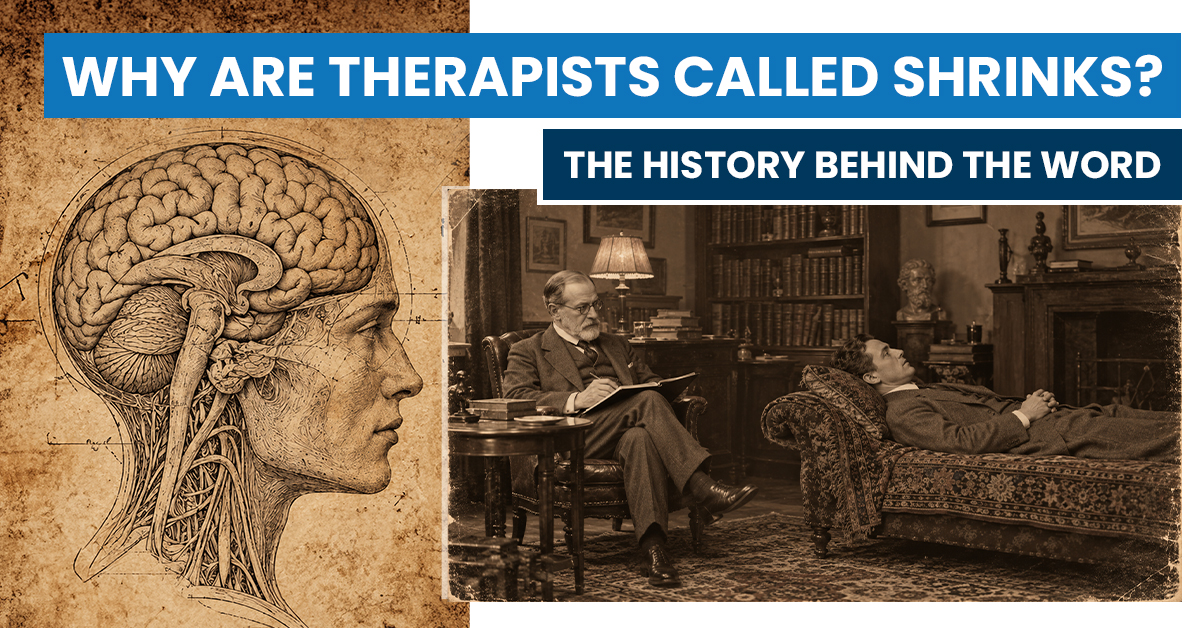
Therapists are called shrinks because the word is a shortened form of “headshrinker,” a slang term documented in American use for psychiatrists by 1950, with the shortened form shrink first recorded in print in 1966. It began as dark humor, drawing a comparison between psychiatrists and tribal practitioners who literally shrank the heads of enemies, implying that therapists did something similar with the mind. It was irreverent, a little unsettling, and exactly the kind of joke that tends to stick.
Most people have used the word shrink at some point, whether casually, humorously, or with a little nervous deflection when talking about seeing a therapist. But very few people know where it actually came from, or why a word rooted in tribal ritual ended up describing one of the most important professions in modern medicine.
The story is stranger, richer, and more revealing than you might expect. It touches on ancient cultural practices, mid-century American pop culture, a Nobel Prize-winning novelist, and a quiet but real conversation about stigma that the mental health world is still having today.
Key Takeaways: Why Are Therapists Called Shrinks?
- Shrink is a shortened form of headshrinker.
- Headshrinker is documented as U.S. slang for a psychiatrist by 1950.
- The shortened form shrink is first documented in print in Thomas Pynchon’s 1966 novel The Crying of Lot 49 and became more widely used in the 1970s.
- The word originated as informal slang rooted in a darker implication: that a psychiatrist, like a tribal headshrinking practitioner, held a kind of power over what was inside a person’s head, accessing and reshaping it in ways the patient could not fully see or control.
- Headshrinker originally referred to psychiatrists. Today, dictionaries define shrink as slang for a psychiatrist or psychologist, and it is used loosely for any mental health professional.
- The word’s history reflects decades of cultural ambivalence about mental health treatment.
Summary Table: The Word Shrink at a Glance
| Feature | Detail |
|---|---|
| Word origin | Shortened from headshrinker |
| First slang use | Headshrinker documented in U.S. slang by 1950. The shortened form shrink documented by 1966 |
| First documented printed use of the mental-health slang sense | Thomas Pynchon, The Crying of Lot 49, 1966 |
| Original implied meaning | A professional who held power over what was inside a patient’s head, accessing and reshaping it in ways the patient could not fully see or control |
| Original target | Psychiatrists, later extended to psychotherapists and other mental health professionals |
| Modern usage | Loosely applied to any mental health professional |
| Tone | Informal, can be dismissive or devaluing depending on context and the professional hearing it |
| Is it still used today? | Yes, commonly in conversation, television, and film, though many professionals prefer precise titles |
Why Are Therapists Called Shrinks?
Therapists are called shrinks because the word is a shortened form of “headshrinker,” documented as U.S. slang for a psychiatrist by 1950, with the shortened form shrink first recorded in print in 1966. The word carried a darker implication: that a psychiatrist, like a tribal headshrinking practitioner, held a kind of power over what was inside a patient’s head, accessing and reshaping it in ways the patient could not fully see or control.
The reason the word attached itself so firmly to the profession is not just about etymology. It is about how Americans felt about psychiatry at the time. Psychoanalysis was booming in postwar America, mysterious, expensive, and vaguely threatening to many people. Calling a psychiatrist a headshrinker, later shortened to shrink, was a way of cutting that intimidating figure down to size with a word. It was mockery and familiarity at the same time.
Why is a therapist called a shrink? Because the word gave ordinary people a way to talk about mental health care without fully admitting they needed it. That dynamic, using humor to approach something frightening, tells you a great deal about the stigma that has long surrounded mental health treatment.
The word was further cemented in popular culture through films, television, and literature across the 1960s and 1970s. By the time The Bob Newhart Show introduced the world to a genial Chicago therapist in 1972, the word shrink was gaining wide cultural traction and losing most of its original edge
Why Are Psychiatrists Called Shrinks?
Psychiatrists are called shrinks because the word headshrinker, documented as Hollywood jargon for a psychiatrist by 1950, was originally coined to describe them specifically. The term captured a cultural anxiety about what psychiatrists did behind closed doors: accessing and reshaping the hidden contents of a patient’s mind in ways that felt as mysterious and unsettling as the tribal practice the word referenced.
In the early days of American psychoanalytic culture, psychiatrists were the dominant figures in mental health care. They were the ones conducting intensive, multi-year psychoanalytic treatment inspired by Freud, probing the unconscious, interpreting dreams, and charging fees that placed them firmly in the upper tier of medicine. They were also the ones who attracted the most cultural attention and the most cultural skepticism.
The term headshrinker first appeared in American media in reference to this specific group: the psychoanalytically trained psychiatrist who seemed to spend hours getting inside a patient’s head. A 1950 article in Time magazine described headshrinker as Hollywood jargon for a psychiatrist, one of the earliest documented uses of the term in print, offered in a tone that was sardonic and culturally knowing.
Why are psychiatrists called shrinks rather than therapists? Because when the word was coined, psychiatrists were the mental health profession. General therapists and counselors as we know them today were not yet the widespread clinical presence they have since become. The word grew up alongside the profession it mocked, and the two have been intertwined ever since.
What Does Shrink Mean?
Shrink means, in informal American English, a psychiatrist, psychologist, or therapist. It is a slang term with no clinical meaning, carrying a tone that ranges from casual and affectionate to dismissive or devaluing depending on the context and the professional hearing it.
The word functions today as a cultural shorthand. When someone says they are seeing their shrink, they usually mean they are in therapy or psychiatric care of some kind. The specific credential of the provider, whether they are an LCSW, a psychologist, or a board-certified psychiatrist, is not implied by the word. It simply means a mental health professional.
What does shrink mean in the context of its origin? It meant something considerably more pointed. The original metaphor was about reduction, specifically the idea that a psychiatrist could get inside your head and reshape it, the way a headshrinking ritual reduced a physical skull. Over time, the darker edges of that image softened. The word became more casual and less threatening, moving from mockery to shorthand as therapy itself became more normalized in American culture.
Shrink Definition Slang
In American slang, shrink means a mental health professional, most commonly a psychiatrist, psychologist, or therapist. It is informal, widely understood, and carries no clinical meaning. The tone ranges from casual shorthand to mildly dismissive depending on context, and many professionals prefer precise titles such as therapist, psychiatrist, or psychologist over the slang term.
The word is part of a long American tradition of using humor to approach topics that feel uncomfortable. Mental health has historically been one of those topics. Saying “I’m seeing my shrink” has always been easier for a lot of people than saying “I am in psychiatric treatment.” The slang created a side door into a conversation that the front door made feel too heavy. And that accessibility is a big part of why the word stuck around for as long as it has.
Today, shrink shows up regularly in television, film, novels, and everyday conversation. Some patients use it affectionately. Others use it matter-of-factly. Many of the professionals it describes find it mildly irritating. The word has outlasted multiple generations of mental health reform and public awareness campaigns, which says something real about how deeply it is woven into the way Americans talk about the mind and the people who help care for it.
Origin of Shrink for Psychiatrist
The origin of the word shrink for psychiatrist is not a single moment but a chain of cultural connections, each one a little stranger than the last. It begins far from any therapist’s office, in the jungles of South America.
The Tribal Headshrinking Practice
The word headshrinker, from which shrink derives, is rooted in a real cultural practice. Certain indigenous groups in the Amazon basin, most notably the Shuar people of Ecuador and Peru, practiced the ritual creation of tsantsas: shrunken heads made from the skin and hair of severed human heads after the skull was removed.
The process was intentional and carried deep ceremonial meaning within Shuar culture. After the skull was removed and discarded, the skin and hair were briefly soaked in hot water, then hot sand was poured inside the skin cavity and the treatment repeated several times, gradually reducing the head to roughly the size of a fist while carefully reshaping the facial features after each stage. The result was called a tsantsa. It was not a trophy in the Western sense. The Shuar believed the tsantsa trapped the muisak, the avenging soul of the defeated enemy, containing its spiritual power and preventing it from returning to retaliate against the living. The shrinking ritual was, at its core, an act of control over a dangerous and invisible force. That image, a practitioner who could reduce, contain, and neutralize something that lived inside a human head, was precisely what made it available as a metaphor for psychiatry a century later.
Western explorers and anthropologists brought accounts of this practice back to Europe and North America throughout the 19th and early 20th centuries, where it became a source of fascination, sensationalism, and no small amount of cultural misrepresentation. By the time the practice entered mainstream Western consciousness, it had been stripped of its ceremonial meaning and reduced to a lurid image: the shrunken head as symbol of primitive otherness.
That image, vivid and unsettling, was precisely what made it available as a metaphor.
From Headshrinker to Shrink: How the Word Evolved
The leap from tribal ritual to psychiatric slang happened during a very specific cultural moment: the peak of psychoanalysis in American psychiatry and popular culture during the 1950s and early 1960s.
Psychiatrists were the dominant figures in mental health care at the time, conducting intensive, multi-year psychoanalytic treatment aimed at uncovering unconscious conflict, reshaping personality, and reaching into the deepest corners of the mind. To a lot of Americans, that was equal parts fascinating and unsettling. The image of a trained professional getting inside your head and quietly rearranging things was powerful, and not entirely comfortable. The slang captured that feeling perfectly, and it spread.
The term likely drew on Western images of headshrinking and on public suspicion about what psychiatrists did to people’s minds, but the exact motivation is uncertain. What is documented is the result: headshrinker began appearing in American usage as slang for a psychiatrist, with the connection between the tribal image and the psychiatric profession taking hold in popular culture through the mid-to-late 1950s.
A 1950 article in Time magazine described headshrinker as Hollywood jargon for a psychiatrist, one of the earliest documented uses of the term in print, offered in a tone that was sardonic and culturally knowing. The word was already circulating in conversation before it appeared in print, as slang typically does before it solidifies into text.
The shortening from headshrinker to shrink followed naturally, as slang almost always contracts over time. By 1966, shrink is documented in print. According to the Oxford English Dictionary, the first documented appearance of shrink in its modern psychiatric slang form in published literature was in Thomas Pynchon’s 1966 novel The Crying of Lot 49, in which the protagonist refers to her deeply unethical psychiatrist as ‘Dr. Hilarius, her shrink or psychotherapist,’ a choice that was anything but accidental. Pynchon placed the word in the context of a dangerous, deceptive doctor, reinforcing every dark implication the slang already carried. It became more widely popular in the United States in the 1970s.
Timeline: How the Word Shrink Entered the English Language
| Date | Event | Significance |
|---|---|---|
| 19th to early 20th century | Western accounts of Amazonian tsantsa rituals circulate in Europe and North America | Creates the cultural image of the headshrinker in Western consciousness |
| 1950 | Headshrinker documented as Hollywood jargon for a psychiatrist in Time magazine | One of the earliest documented printed uses of the term. Became more established in the mid-to-late 1950s |
| 1950s to early 1960s | Psychoanalysis reaches peak influence in American psychiatry and popular culture | Creates the cultural context in which the headshrinker metaphor gains broader traction |
| 1966 | Thomas Pynchon uses shrink in The Crying of Lot 49 | First documented use of the shortened form in published literature, per the Oxford English Dictionary |
| 1970s | Shrink becomes more widely recognized in U.S. popular culture, including through television and entertainment | Word gains broader popular usage beyond subcultural or regional slang |
| Present | Shrink used loosely for any mental health professional | Word persists as informal shorthand, though many professionals find it reductive |
Shrink Psychiatrist Meaning
When applied specifically to a psychiatrist, shrink originally referred to a psychoanalytically trained medical doctor who conducted intensive treatment aimed at accessing and reshaping a patient’s psychological structure from the inside. The metaphor was pointed: the psychiatrist was imagined as someone who held power over the vast, unmanageable contents of the unconscious mind, reducing them into something the patient could understand and live with. That implied power dynamic is what the word was really about.
That image has mostly disappeared from how the word lands today. In casual conversation, shrink has become something far simpler: a shorthand for a mental health doctor who can diagnose and prescribe. The psychoanalytic undertones have gradually worn away as psychiatry has moved toward evidence-based biological treatment and integrated care models. What is left is just the word, still turning up in conversation, still recognizable, but carrying far less of the cultural charge it once did.
If you want to understand what a psychiatrist actually does today, rather than what the word shrink implies, the article Psychiatrist vs. Therapist: What’s the Difference and Who Do You Need? covers that in full.
Are Shrinks Psychologists or Psychiatrists?
The word shrink originally referred to psychiatrists specifically, but today it is used loosely for any mental health professional, including psychologists, therapists, and counselors.
When headshrinker first appeared as slang in the 1950s, psychiatrists were the clear center of gravity in mental health care. Psychoanalysis was their territory, and the metaphor was aimed directly at them. Psychologists at the time occupied a different space, focused more on assessment, testing, and research than on the kind of intensive, get-inside-your-head clinical treatment the word was poking fun at. The slang was not about mental health professionals broadly. It had a specific target.
Over time, as therapy became more widespread and the lines between mental health professions blurred in the public imagination, shrink expanded to cover the whole field. Today most people use it without making any distinction between a psychiatrist, a psychologist, or a licensed therapist. The word has lost the specificity it once had.
For the record, the clinical distinctions between these professionals are real and meaningful, even if the slang does not reflect them. A psychiatrist is a physician, either an MD or DO, who can diagnose and prescribe medication. A psychologist holds a doctoral degree and specializes in assessment and therapy but generally cannot prescribe. A licensed therapist holds a master’s degree and provides talk therapy and behavioral treatment. For a full breakdown of how these roles differ, see Psychiatrist vs. Therapist: What’s the Difference and Who Do You Need?.
Shrink Vs Therapist: Is There a Difference?
Shrink is a slang term with no clinical meaning, while therapist is a professional title backed by specific licensing requirements, supervised clinical hours, and state-regulated scope of practice. The two are not interchangeable. Calling a provider a shrink tells you nothing about their training, credential, or what they actually do. Calling them a therapist signals a defined category of licensed mental health care.
When someone refers to their provider as their shrink, they are using informal shorthand that tells you nothing about who that person actually is, what they are trained to do, what they are licensed to practice, or what happens in a session with them. A psychiatrist and an LCSW are both sometimes called shrinks in casual conversation, even though one is a medical doctor with prescribing authority and the other is a master’s-level clinician whose work is grounded in talk therapy. The word takes a meaningful, important distinction and collapses it into a single casual syllable.
Therapist, by contrast, is a title that implies a specific category of licensure: a trained, credentialed mental health clinician who provides structured, evidence-based treatment. It does not carry the cultural baggage the word shrink does, and it more accurately describes what most people who seek mental health care are actually looking for.
The psychiatrist vs. shrink distinction follows the same logic. Calling a psychiatrist a shrink reduces a highly specialized medical professional to a pop culture caricature. It is not necessarily malicious, but it does reflect a habit of treating mental health care as less serious than other forms of medicine.
None of this means you cannot use the word. Language is informal and people communicate how they communicate. But knowing the difference between a slang term and a clinical title is part of understanding what you are actually looking for when you decide to get help. If you are trying to figure out which type of mental health professional is right for your situation, What Does a Therapist Do? is a good place to start.
Is It Offensive to Call Someone a Shrink?
Calling a mental health professional a shrink is not universally offensive, but many practitioners find it reductive or disrespectful. The word originated as mockery, rooted in cultural suspicion about what psychiatrists did to people’s minds, and that history does not disappear simply because the term has become casual over time. Understanding why it lands the way it does matters if you care about how you talk about mental health.
Many mental health professionals accept the word with a degree of resigned familiarity. Some use it themselves, particularly in informal contexts, as a way of being approachable. Others find it genuinely diminishing, the clinical equivalent of calling a surgeon a knife jockey or a cardiologist a heart mechanic. It reduces years of rigorous training to a crude metaphor.
The more important issue is what the word reveals about how we collectively think about mental health care. Most people would never reach for slang to describe a visit to a cardiologist or an oncologist. The fact that we do it so easily with therapy is worth pausing on. That asymmetry reflects a cultural habit of treating mental health as somehow less legitimate than physical health, and that habit has real consequences. It quietly discourages people from seeking care they genuinely need.
Using the word casually is not a moral failing. Language is informal, and people use shorthand for all kinds of things. But choosing more precise language, therapist, psychiatrist, psychologist, is a small and meaningful act. It is a way of treating mental health care with the same seriousness we extend to every other branch of medicine. And for a lot of people, that shift in how we talk about it is the first step toward changing how we feel about asking for it.
At OneMed Clinic, we see this regularly in practice. Patients come in having waited months or years to ask for help, not because they did not know something was wrong, but because the way they thought about mental health care made it feel less urgent than a physical symptom. A persistent low mood or chronic anxiety deserves the same attention as high cholesterol. If you have been putting off that conversation, meet our therapy and psychiatry team at OneMed and let us make the first step straightforward.
Why the Word Still Matters: Shrink, Stigma, and Modern Mental Health
The word shrink has been in circulation for roughly sixty years, first appearing in print in 1966 and picking up wide popular use through the 1970s. The original metaphor imagined the psychiatrist as someone who held power over a patient’s mind, much like the Shuar practitioner who trapped and contained a dangerous spiritual force. Modern therapy works in the opposite direction entirely: a good therapist does not hold power over your mind. They build your capacity to hold power over it yourself.
The fact that it has survived this long, through decades of mental health awareness campaigns, therapy normalization, and genuine cultural shifts in how we talk about the mind, is worth paying attention to.
Language shapes how we see things. The words we use to describe mental health care quietly influence how people feel about seeking it. A word rooted in mockery, even one that has softened considerably over time, still carries an undertone. It suggests that therapy is something slightly embarrassing, vaguely comic, or less serious than other forms of medical treatment. For someone already hesitant about asking for help, that undertone is not nothing. It lands.
The good news is that the conversation has genuinely shifted. Therapy is more normalized today than at any point in American history. More people are seeking help earlier, talking more openly about their experiences, and treating mental health care as a routine part of looking after themselves rather than a last resort they only reach for when everything else has failed.
In many ways, shrink is a relic of a different era. An era when admitting you needed help with your mental health was something people only did quietly, and when the professionals who provided that help were viewed with a mix of curiosity and suspicion. That era is not entirely behind us. But it is receding, and the language we choose is one of the small ways we help move it further back.
At OneMed Clinic, we believe that the language we use around mental health care matters as much as the care itself. Our therapy team and psychiatry team are not shrinks in any sense the word implies. They are board-certified physicians, licensed clinicians, and trained specialists who take your care seriously, because you deserve nothing less.
FAQs About the Word Shrink
The word shrink raises more questions than most people expect. The most common ones, are below.
Where Did the Term Shrink Come From for Therapists?
The term shrink came from headshrinker, documented as U.S. slang for a psychiatrist by 1950. It carried a pointed implication: that a psychiatrist, like a tribal headshrinking practitioner, held power over what was inside a patient’s head. The word shortened naturally to shrink, with the abbreviated form first documented in print in Thomas Pynchon’s 1966 novel The Crying of Lot 49.
Is It Offensive to Call a Therapist or Psychiatrist a Shrink?
Calling a mental health professional a shrink is not universally offensive, but many practitioners find it reductive. The word originated as mockery rooted in cultural suspicion about psychiatric power over patients, and that history does not disappear because the term has become casual. Choosing precise language, therapist, psychiatrist, or psychologist, is generally more respectful and more accurate.
Why Is the Word “Shrink” Considered Derogatory by Some Mental Health Professionals?
Some mental health professionals consider shrink derogatory because it reduces years of rigorous clinical training to a slang term rooted in mockery and cultural suspicion. For practitioners who have completed medical school, doctoral programs, or thousands of supervised clinical hours, being referred to by a term that originated as a joke carries a dismissiveness that is difficult to separate from its history.
Does Shrink Refer to a Therapist, Psychiatrist, or Psychologist?
Shrink originally referred to psychiatrists but today is used loosely for any mental health professional. The word carries no clinical meaning and makes no distinction between credentials or scope of practice. A psychiatrist is a physician who can prescribe medication. A psychologist holds a doctoral degree. A therapist holds a master’s-level license. All three are sometimes called shrinks, but the word accurately describes none of them.
Who First Coined the Term Shrink for a Mental Health Professional?
No single person coined the term shrink. It evolved from headshrinker, most likely circulating informally before its first documented appearance in print in Thomas Pynchon’s 1966 novel The Crying of Lot 49, in which the protagonist refers to her psychiatrist as her shrink or psychotherapist. Pynchon recorded the word. The culture created it.
Is the Word Shrink Still Commonly Used Today?
Yes. Shrink remains in common informal use in the United States, appearing regularly in conversation, television, film, and literature. Its usage has broadened from psychiatrists specifically to any mental health professional. Many practitioners still find it reductive, and the clinical community generally prefers precise titles: therapist, psychiatrist, or psychologist.
Conclusion
The word shrink traveled a long and unlikely road to get where it is today. From Amazonian ritual to postwar American slang to a throwaway line in a 1966 novel to the casual vocabulary of millions of people, it has outlasted the cultural moment that created it and the stigma that sustained it.
What the word really tells us is how complicated our relationship with mental health care has always been. Using humor and irreverence to approach something frightening is deeply human. But the fear that gave rise to the word is, for many people, diminishing. Therapy is no longer something most people feel they need to disguise with a joke. It is care. Serious, evidence-based, life-changing care delivered by trained professionals who have dedicated their careers to helping people feel better.
The word shrink belongs to the past. What it points toward is very much present.
Curious About What Modern Therapy Actually Looks Like?
If the history of the word has made you curious about the reality of what therapy involves today, What Does a Therapist Do? answers that in full. And if you are ready to take the next step, book your first appointment with OneMed Clinic and meet a team that takes your care as seriously as you do.
Merriam-Webster. Headshrinker.
https://www.merriam-webster.com/dictionary/headshrinker
Etymonline. Head-shrinker.
https://www.etymonline.com/word/head-shrinker
World Wide Words. Shrink.
https://www.worldwidewords.org/qa/qa-shr1.htm
Pitt Rivers Museum, University of Oxford. Shrunken Heads.
https://www.prm.ox.ac.uk/shrunken-heads
Pitt Rivers Museum, University of Oxford. Proyecto Tsantsa.
https://www.prm.ox.ac.uk/proyecto-tsantsa
American Psychiatric Association. What Is Psychiatry?
https://www.psychiatry.org/patients-families/what-is-psychiatry
National Institute of Mental Health (NIMH). Psychotherapies.
https://www.nimh.nih.gov/health/topics/psychotherapies


